|
Toronto CMA 2003 Industry Profiles
The Economic Development Division of the City of Toronto has produced industry profiles for 208 industries (including sub-totals) in the Toronto CMA. Each industry profile contains information on employment such as: total employment, employment by gender, by age group etc.
University of Toronto
The University of Toronto is Canada's largest and most distinguished research-intensive university. It is consistently ranked as Canada's "intellectual powerhouse" with over 300 undergraduate programs, 75 PhD programs and 14 professional faculties. Access well-educated and job ready students and recent graduates.
|
Labor Force
Employment by Sector | Labor Force Availability | The Creative Workforce
Employment by Sector
The Toronto region has one of the most diversified economies in the world. While the service sector plays an important role, manufacturing continues to be a significant employer.
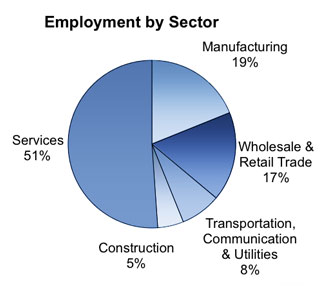
Source: Statistics Canada 2001.
In 2003, the GTA manufacturing sector employed 473,240 employees.

Source: City of Toronto, Toronto CMA 2003 Industry Profiles.
Top of Page
Labor Force Availability
The current GTA labor force of 3.1 million represents 45.5% of the total labor force in Ontario and it is expected to grow to 4.1 million by 2031.
| |
GTA |
ONTARIO |
CANADA |
| Population 15 years + |
4,501,700 |
10,017,800 |
25,738,900 |
| Labor Force |
3,098,000 |
6,803,200 |
17,261,500 |
| Employment |
2,879,800 |
6,381,700 |
16,112,900 |
| Unemployment |
218,300 |
412,500 |
1,148,600 |
| Unemployment Rate |
7.00% |
6.20% |
6.00% |
Source: Statistics Canada, Labor Force Surveys; Toronto Area Economist, Economic Analysis
and Information Directorate, Ontario Region, January 2005.
In 2004 the unemployment rate in the Toronto Region was 7.4 percent

Source: Statistics Canada, Labor Force Surveys, (Greater Toronto Region 530).
Relative to other North American cities qualified labor is readily available in the GTA.
2003 Average Annual Unemployment Rates Toronto vs. U.S. cities

Sources: Statistics Canada, Labor Force Survey, 2003; US Bureau of Labor Statistics, 2003.
With a total enrolment of 225,000 students, Greater Toronto Area universities and colleges are an important resource for a skilled future workforce.
| Toronto |
47,459 |
Seneca |
29,472 |
| York |
34,101 |
Humber |
25,450 |
| Ryerson |
12,451 |
Sheridan |
23,188 |
| Ontario College of Art & Design |
1,921 |
Centennial |
21,202 |
| Ontario Institute of Technology |
940 |
George Brown |
19,181 |
| |
|
Durham |
10,582 |
| Total |
96,872 |
|
129,075 |
Source: Ministry of Training, Colleges and Universities.
*Note: Certain Ontario Colleges offer degree granting programs in addition to diplomas.
Top of Page
The Creative Workforce
The GTA attracts people who drive the knowledge industry
In his recent book, The Rise of the Creative Class (2002), Dr. Richard Florida explores the emergence of the “Knowledge Economy” and how creative people, those that generate innovations, drive the economic growth of metropolitan areas.
Dr. Florida explains that cities or regions open to diverse ways of life are the most likely to attract this creative class. Based on some recent work, he found that the Greater Toronto Area is one of the top regions in North America for its creativity and diversity.
- 2nd in Canada for its “Bohemian” population and 4th in North America, ahead of San Francisco
The “Bohemian Index” is defined using employment in artistic and creative occupations.
- 1st in North America for its multiculturalism. Internal link to Population/multiculturalism
The “Mosaic Index” indicates the total population that is foreign born.
Sources: Institute for Competitiveness and Prosperity, 2002. Data based on the work of Dr. Richard Florida, “The Rise of the Creative Class” (2002).
Top of Page
|




